Minecraft if I Put Wood Will It Grow Again
This article is most Overworld trees. For End trees, run across Chorus tree. For the institute that grows into a tree, see Sapling. For Nether tree-like structures, see Huge fungi.

This commodity needs to exist updated.
Please update this folio to reflect recent updates or newly available information.
Reason: Add together mangrove tree
A tree is a common terrain feature that mainly consists of log and leafage blocks. There are eight types of copse – oak, spruce, birch, jungle, acacia, nighttime oak, azalea and mangrove[ upcoming: JE 1.nineteen]. Other structures are loosely defined as trees: the huge mucus, huge mushroom, and chorus tree.
Contents
- 1 Structure
- 2 Growth and characteristics
- 3 Types of trees
- 3.one Oak
- 3.two Bandbox
- three.3 Birch
- 3.4 Jungle
- 3.5 Acacia
- 3.vi Dark oak
- 3.7 Azalea
- 3.8 Mangrove
- three.nine Huge mucus
- three.10 Huge mushroom
- 3.11 Chorus tree
- iii.12 Variant trees
- three.12.1 Dying trees
- 3.12.2 Fallen trees
- 4 Leaf colors
- 5 Information values
- v.one ID
- half-dozen Video
- vii History
- eight Issues
- 9 Trivia
- 10 Gallery
- 10.1 Odd generation
- 10.2 Official artwork
- 11 References
Structure [ ]
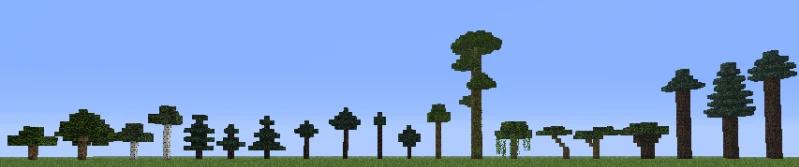
The trees found in Minecraft, excluding azalea trees.
Trees vary widely in height, from a bare minimum of ane log cake for bush copse, ranging up to a maximum of 30 blocks for giant jungle trees.
Tree canopies are composed of leaf blocks and abound 1 cake higher than the highest log block (except those of the behemothic oak tree, whose leaves abound three blocks higher). The canopy may begin from the basis and go upwardly to vi blocks from the ground. Tree canopies are generated from roughly spherical clusters of leaves almost v–vii blocks across, centered on sections of torso or branches. Leaves must be supported by an adjacent trunk (or leaf blocks connected to the trunk); otherwise, they disappear.
Large oak, dark oak, and behemothic jungle trees grow branches (logs continued horizontally, vertically, or diagonally to the trunk or other branches). Most of the fourth dimension, a single tree has between i and six branches, and each co-operative has between one and 6 logs. Acacia tree branches do not embrace their branches in this way.[ more than data needed ] Regular oak, jungle, birch, and spruce trees (both small and large) lack branches.
Growth and characteristics [ ]
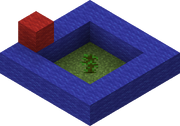
This jungle tree cannot abound because of the cerise wool block (looking from the northwestern corner)
Trees are created when chunks are generated, and can also exist grown from saplings.
Tree saplings have a one⁄xx take chances (i⁄40 if they are jungle saplings) of dropping from leafage blocks when they disuse or are destroyed. In that location are six species of saplings, corresponding to the vi main trees: oak, birch, spruce, jungle, acacia, and night oak.
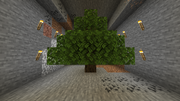
A tree that was grown in a cavern, with the necessary light provided by torches.
The sapling can be planted on whatever variant of dirt (except dirt path) a moss cake or a mud[ upcoming: JE one.nineteen], and must accept a light level of at to the lowest degree 8 in the sapling block.
A sapling uproots with light level 7 or less in the sapling block itself unless information technology has a view of the heaven that is unobstructed (except by drinking glass or other transparent materials). The sapling must have at least 6 blocks of space above information technology to grow; the corporeality of required space varies betwixt the different species of trees. A ceiling above sapling limits the maximum height of the tree that can grow from that sapling. However, dirt blocks and logs may not prohibit tree growth, and in some cases may be replaced as a sapling attempt to abound through them. However in Bedrock edition, logs prohibit tree growth.
If multiple saplings are planted next to each other, each one grows as long equally the leaves from the other grown saplings do not cake also much of the sunlight. Artificial light (torches, etc.) can still be used to grow them if this happens.
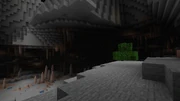
Trees can be generated anywhere where there is light and dirt.
All trees in the active chunk radius effectually the role player make attempts to grow at random intervals. For whatever given tree this tin piece of work out to near 1 growth attempt per minute. When a tree attempts to grow, it beginning checks that it has plenty low-cal, then randomly chooses which variant of that species of tree to go; for example, an oak sapling chooses to grow as either a normal or fancy oak tree.
In one case a tree has passed a light check and chosen size to effort, it checks if there is plenty space for its chosen size. If information technology encounters an obstruction during this check, information technology fails to grow and must wait for the adjacent pass before information technology tin attempt to abound again. This ways that a tree in an open field with enough lite grows relatively quickly, just a tree in a cramped tree farm that stunts its size may make several attempts before finally growing.
Bone meal, when used on a sapling, has a chance of forcing it to grow, so long as all of the normal checks (calorie-free, space, dirt, etc.) accept passed. It does not guarantee growth, simply forces an try to grow.
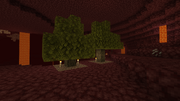
Planting copse in the Nether
All saplings abound normally in the Nether and in the Finish, although they must be planted in clay transported from the Overworld and provided with sufficient light and space. Leaf blocks in the Under take the same color as if they were placed in a desert biome. In the end, they are a slow blue-green, as in the windswept hills biome.
In order to grow a 2×two tree (exist it bandbox, jungle or dark oak), iv saplings must be placed adjacent to each other in a square. For growth to succeed, at that place must exist no blocks side by side (even diagonally) to the north-western side upwards to the final height of the tree. The bone repast can be used on any of the saplings. The largest jungle and bandbox trees reach 31 blocks tall. Dark oak trees are typically vi–8 blocks alpine.
Leaves and logs removed from a tree do not grow back over fourth dimension.
When a sapling on a grass block or mycelium grows into a tree, the grass block or mycelium is instantly converted to clay.
Types of trees [ ]
Oak [ ]
Main article: Oak
Oaks are among the virtually common trees in the game. They have the smallest space requirements, and forth with night oak trees, they tin drop an apple when a leaf cake is destroyed. In swamp biomes, a slightly larger variant of the regular oak tree with vines is generated, which can naturally generate in shallow water. Large (or "fancy") oaks may also abound or generate in place of regular oaks; these are taller and may feature branches. A rare variant is its smallest configuration, colloquially known as a "airship" oak.
-

An oak tree.
-

A large oak tree.
-

A "airship" oak tree.
-

A swamp oak tree.
Bandbox [ ]

This section would benefit from the addition of isometric renders.
Please remove this observe once you lot've added suitable isometric renders to the article.
The specific instructions are: Some of the other bandbox variants
Bandbox trees grow from spruce saplings and have growth patterns and requirements like to birch trees, although they appear different. They are mainly establish in the taiga biome, but they may also generate in windswept wood, snowy plains, snowy taiga, and old growth taiga biomes. Spruce logs have the aforementioned texture every bit oak logs, but it is a darker shade of brown; its leaves are denser, with a darker and more blue tone.
-

A spruce tree.
-
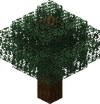
A "lollipop" bandbox tree.
-
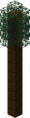
A "matchstick" bandbox tree.
-
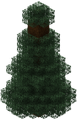
A large bandbox tree.
-
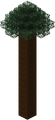
A large "lollipop" spruce tree.
Birch [ ]
Birch trees wait fairly similar to small oaks in terms of height and are most commonly found in birch forest biomes. In that location are two types of birch: a shorter tree that tin be grown by the actor with birch saplings; and a taller, rarer variety that generates just naturally in tall birch forest biomes.
-

A birch tree.
-
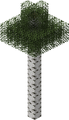
A tall birch tree.
Jungle [ ]
Jungle trees are one of the rarest naturally generated trees in Minecraft considering they are native to the jungle biomes, which are themselves rare. Jungle tree leaves drop jungle tree saplings. When planted in grass or clay they abound into a jungle tree with a 1×1 trunk, merely the player can place them in a 2×2 germination to grow a jungle tree with a 2×2 body like the trees plant naturally in the jungle biome. Bushes also generate in the jungle biome, featuring oak leaves and a single jungle log.
-
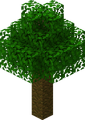
A jungle tree.
-
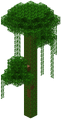
A large jungle tree.
-

A jungle bush.
Acacia [ ]
This section would benefit from the addition of isometric renders.
Please remove this notice once you've added suitable isometric renders to the commodity.
The specific instructions are: All acacia tree variants
Acacias are plant in the savanna biome. They are most 8 blocks tall and feature unique diagonal trunks, and may occasionally accept multiple canopies.
-

An acacia tree.
Dark oak [ ]
Dark oaks are constitute in the dark forest biome. They accept thick 2×2 trunks. A night oak ever generates with dirt blocks under its trunk, even on a steep cliff. Irregular logs, representing large branches, are nearly always present and connected to the trunk. The awning of a night oak filters enough calorie-free that a dumbo forest of them is sufficiently dark for hostile mobs to spawn during the daytime.
-
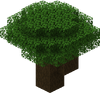
A night oak tree.
-
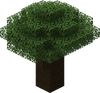
Another dark oak tree.
Azalea [ ]
The counterpart to the existent-earth azalea shrub takes the form of a tree in Minecraft. Azalea trees generate on whatever empty space higher up a lush cave, with roots consisting of rooted dirt and hanging roots that reach downwards to the lush cavern. The tree usually appears at the surface, but they tin generate inside caves if there is enough room and a lush cave beneath.
Azalea trees can be manually grown by applying bone repast to an azalea or flowering azalea block ("bush"). Unlike most copse, they exercise not have their own wood blazon (the trunks are equanimous of oak logs), but they accept 2 types of leaf block: azalea leaves, and flowering azalea leaves.
-
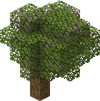
An azalea tree.
Mangrove [ ]
Mangroves are found in muddy mangrove swamps, growing in water or on land. They are grown from propagules, which can exist obtained past punching the copse. A mangrove converts whatsoever mud around it to muddy mangrove roots. The wood has a deep cherry-orange color.
-
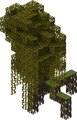
A mangrove tree.
Huge fungus [ ]
Huge fungi come in many shapes and sizes, from really small to really huge. Their trunks are equanimous of "stalk" blocks which are nearly identical to wooden logs, except for being not-combustible. In place of leaves they take nether wart blocks or warped wart blocks, with occasional shroomlights embedded within them. Crimson huge fungi often generate with weeping vines.
Huge crimson fungi are found in the cerise woods biome; huge warped fungi are found in the warped forest biome.
They tin can be grown from crimson or warped fungus, placed on cherry nylium or warped nylium. To grow into a huge fungus, the original fungus must be planted on the matching type of nylium, then bone meal practical to information technology.
-
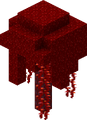
A huge crimson mucus.
-

A huge warped fungus.
Huge mushroom [ ]
While loosely defined as a tree, these are structures generated in certain biomes. Instead of logs and leaves, they consist of mushroom stems and mushroom blocks, which don't decay. When harvested without Silk Bear upon, they drop mushrooms. They come in two variants, brown and scarlet.
-

A huge scarlet mushroom.
-

A huge brown mushroom.
Chorus tree [ ]
While loosely defined as a tree, these are structures generated on the outermost End islands. Instead of logs and leaves, they are instead comprised of chorus constitute trunk blocks and flowers on the tip. They do not drop their own block but instead chorus fruit. They are usually extremely tall, with multiple branches. When the bottom of the chorus tree is cut, the whole chorus tree falls apart, dropping their fruit. The branches are tipped with "chorus flowers", which exercise not drop when the tree is broken, but tin separately exist broken (and dropped) by whatsoever tool, bare hands, or the impact of any projectile. When a chorus flower is placed on Finish stone, it grows into a chorus tree over fourth dimension — different almost copse, this is a step-wise process every bit the chorus flower generates branches ane block at a time.
-
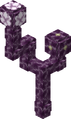
A chorus tree.
Variant copse [ ]

In Bedrock and Instruction editions, trees can generate as one of the two following variants of the normal tree. Both of these generate naturally, and can be grown out of normal saplings.[1] [2]
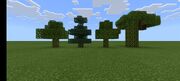
The dissimilar dying tree types.
Dying trees [ ]
These trees have the standard growth pattern of any other tree, all the same, all exposed logs in the master trunk are covered with vines. They tin can generate as dark oak, jungle, spruce, small oak trees or be grown from saplings.
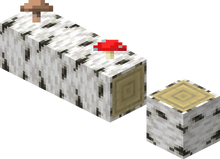
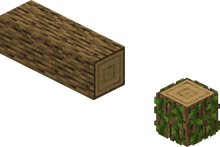
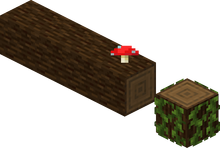
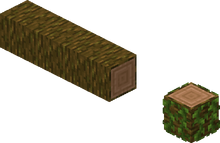
Unlike possible fallen log variants
Fallen trees [ ]
These trees consist of a single upright log, or stump. Logs lying on their side are ofttimes found 1–2 blocks from the stump. Oak, bandbox, birch, tall birch, and jungle trees can generate every bit fallen trees.
Leafage colors [ ]
Main commodity: Tint
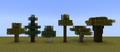
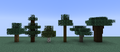
Depending on where the tree generates, the colour of the leaves may differ. For example, if an oak tree is in a colder biome, such as a taiga or windswept hills biome, information technology has a blueish-green hue. In a snowy taiga, the leaves are white with a slight greyness tint. However, if it is in a dry out biome, such equally a desert or savanna, it has a mustard yellow hue. Birch leaves do not follow these rules; it is always the same color regardless of the biome.
-
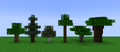
Leafage color in wetter biomes.
-
Foliage color in drier biomes.
-
Foliage color in colder biomes.
Leaves are checked individually for biome coloration rather than as part of a larger tree; as such, trees that were grown between biomes usually take multiple shades on each side.
-
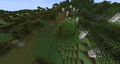
A tree grown between two biomes.
-
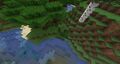
A tree situated on the boundary of a jungle, swamp and desert biome, showing skins of all three on its leaves.
-
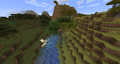
An acacia tree divide betwixt a savanna biome and a swamp biome.
Data values [ ]
ID [ ]
| Name | Identifier |
|---|---|
| [No displayed name] | tree |
Video [ ]
History [ ]

Information technology has been suggested that this page exist split.[talk over ]
If this split may potentially be controversial, do not divide until a consensus has been reached.
Reason: info from this section could be split into the pages for each individual tree type
| Java Edition Classic | |||||
|---|---|---|---|---|---|
| May 21, 2009 | Notch shows interest in adding copse. | ||||
| May 23, 2009 | Notch says he accomplished adding "Trees with a torso and a Canopy". | ||||
| 0.0.14a | Added trees. At this indicate they were available only every bit oak copse with a single leafage color, and were only stumps covered with a thin leaf layer. Foliage is a 3×3×iii cube. | ||||
| 0.0.14a_08 | Inverse tree shape again, this time with a "+" shape in the superlative leaf layer. | ||||
| 0.0.15a (Multiplayer Test one) | Trees have a new shape, resembling modernistic small oak trees. | ||||
| June 14, 2009 | Notch discussed trees every bit part of his vision for resource-balancing in Survival fashion: "You can never directly build wood, simply if y'all plant seeds on grass, yous go a small institute. Later some time, the found volition pop into a big beautiful tree." | ||||
| August 25, 2009 | Demonstrated Trees can at present be grown with saplings. | ||||
| 0.24_SURVIVAL_TEST | The tree growing ability was implemented.[ needs testing ] | ||||
| 0.29_01 | Growing copse on a multiplayer server is at present optional. | ||||
| Java Edition Infdev | |||||
| 20100227-1 | Trees temporarily removed to test basic infinite world functionality. | ||||
| 20100320 | Re-added trees. | ||||
| 20100327 | Trees regenerate after the globe is reloaded. | ||||
| 20100330 | Trees no longer regenerate. | ||||
| 20100413 | New larger trees implemented, using parts of Paul Spooner'southward Forester editor script.[three] [4] | ||||
| 20100420 | These new copse can be grown with saplings. | ||||
| 20100607 | Reverted back to old tree code. | ||||
| Java Edition Alpha | |||||
| v1.0.6 | The big trees were re-added. | ||||
| Java Edition Beta | |||||
| 1.2 | Birch and bandbox trees introduced. Trees predating this update would appear to have multiple types of leaves, as the data indicating tree type was previously used for decay calculations. Oak trees no longer generate in Taigas. | ||||
| 1.5 | Birch and bandbox trees tin now exist grown using saplings. Old saplings either stayed as an oak sapling or became either a birch or spruce sapling. | ||||
| 1.8 | Pre-release | The Swampland biome was added, with a new tree design (fabricated of the same blocks every bit oak trees), which are of more uniform size and have vines growing on them. At that place is no manner to grow these copse; oak saplings grow normal oak trees. A bush-shaped variety of oak tree was removed. | |||
| Java Edition | |||||
| 1.0.0 | Beta 1.nine Prerelease 4 | Trees can sometimes be found growing on blocks of sand in swamp biomes. | |||
| one.2.1 | 12w03a | Added jungle copse. | |||
| 1.iii.1 | 12w19a | Modest jungle trees tin can generate with cocoa already growing on them. | |||
| 1.3.2 | pre | Large oak trees now generate with sideways logs. | |||
| 1.7.two | 13w36a | Mega spruce copse, nighttime oak trees, and acacia trees added. These trees borrowed other trees' leaves and wood. | |||
| Bandbox trees at present generate in ice plains biomes and extreme hills+ biomes in add-on to oak trees. | |||||
| Big oak copse no longer naturally generate in forest biomes. Jeb explained it was due to problems in the big tree generator code that caused severe performance issues.[5] | |||||
| 13w43a | Acacia and roofed oak now have their own wood, leaves and sapling variants. Note that acacia and roofed oak trees generated prior to this snapshot remain unchanged. | ||||
| 1.seven | Renamed "roofed oak" to "dark oak". | ||||
| one.eight.2 | pre4 | Large oak and dark oak branches no longer replace solid blocks. | |||
| 1.9 | 15w44a | Large oak trees now generate in wood biomes again, thanks to an FPS fix provided past Spooner.[6] | |||
| 1.10 | 16w20a | There is now a rare chance to notice lonely copse in plains. | |||
| 1.13 | 18w06a | Large spruce trees now transform nearby grass blocks into podzol when they abound. | |||
| 18w22a | Naturally-generated leaves now survive at a altitude of up to 6 blocks from logs, instead of 4. | ||||
| ane.15 | 19w41a |  The tops of large acacia canopies are now plus shaped.[7] The tops of large acacia canopies are now plus shaped.[7] | |||
| 19w45a |  The tops of large acacia canopies are now again a rotated square The tops of large acacia canopies are now again a rotated square | ||||
| 1.17 | 21w10a | Added azalea trees that generates with azalea leaves, flowering azalea leaves and oak logs. | |||
| Upcoming Coffee Edition | |||||
| 1.19 | 22w14a | Added mangrove trees. | |||
| Pocket Edition Alpha | |||||
| v0.ane.0 | Added oak, spruce, and birch copse. | ||||
| v0.two.1 | Oak trees generate with bandbox forest. | ||||
| v0.four.0 | Oak trees use oak wood once again. | ||||
| v0.ix.0 | build 1 | Added jungle trees (minor and mega), dark oak copse, acacia trees, mega spruce trees, oak trees (swamp and large oak variants), and version-exclusive fallen and dying trees. | |||
| Cold-en oak trees (bandbox trees shaped like oak trees) no longer generate. | |||||
| v0.11.0 | build 1 | Added tall birch tree variant. | |||
| Bedrock Edition | |||||
| ? | Mushrooms no longer generate as role of fallen trees. | ||||
| 1.16.0 | beta 1.15.0.51 | Large spruce trees now transform nearby grass blocks into podzol when they grow. | |||
| Legacy Console Edition | |||||
| TU1 | CU1 | 1.00 | Patch 1 | i.0.1 | Added oak, bandbox, and birch trees. |
| TU12 | Added jungle trees. | ||||
| TU27 | CU15 | 1.18 | Added dark oak and acacia wood, but without their ain leaves or saplings. | ||
| TU31 | CU19 | i.22 | Patch 3 | Added dark oak and acacia saplings. | |
| TU60 | CU51 | 1.64 | Patch 30 | i.0.11 | Added fallen and dying trees. |
| New Nintendo 3DS Edition | |||||
| 0.one.0 | Added trees. | ||||
Issues [ ]
Bug relating to "Tree" are maintained on the bug tracker. Report bug there.
Trivia [ ]
- Floating trees may announced when small above-ground ponds generate in a forested expanse. This happens since the tree is generated when the chunk loads showtime, before the pond appears underneath. This leaves the tree floating above the lake. If the pond is lava, the tree can catch on fire, potentially spreading to other trees and starting a forest fire.
- Large jungle trees and dark oak copse generate with dirt under them if they generate partly or wholly over air or water blocks.
- Oak, spruce, birch, and acacia are all genera of copse.
Gallery [ ]
-
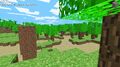
Trees in 0.0.14a.[eight]
-
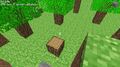
Another former image of a tree, along with its "cross-cutting."[9]
-
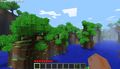
Notch posted this image of the new large copse provided to him by Paul Spooner.[3]
-

Alpine spruce tree in forest in taiga biome.
-
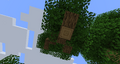
A floating tree, formed artificially afterwards being prepare on burn with a Flint & Steel.
-
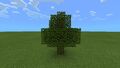
A dying tree in a Pocket Edition.
-
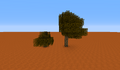
Comparison of oak tree sizes.
-
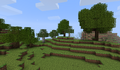
Trees in the Blastoff stages of evolution.
-

A giant dark oak tree (left) and a giant jungle tree (right).
Odd generation [ ]
-

A big tree that was generated on a small floating body of land.
-
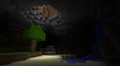
A tree that was naturally generated in a closed-over area of land, with calorie-free provided past a hole in the ceiling.
-
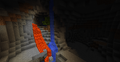
A tree generated in a cavern, with light provided from lava.
-

Trees can even generate in ravines.
-
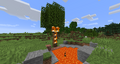
This tree generated right next to a natural lava pool and started to fire soon later.
-

A tree generated on a clay vein in a bowl.
-
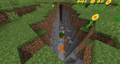
Another ravine tree.
-

Saccharide cane replacing leaves. This can exist hands replicated by finding sugar cane and planting an oak sapling 1 cake away as seen in the prototype. Then use some os repast on sapling and let the tree grow.
-

A tree growing on a clay cake, caused when the clay replaced the dirt.
-

This tree generated on a clay vein in a desert, which was exposed by a bowl.
-
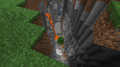
A tree that generated in ravine, next to the lava and mineshaft.
-

Sometimes, trees can grow through blocks placed past player.
Official artwork [ ]
-
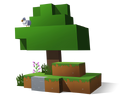
Artwork of an oak tree with a chicken perched on the leaves.
References [ ]
- ↑ http://i.imgur.com/hTg0N8J.gifv
- ↑ "[MCPE-21304] Tree falled - Planted saplings sometimes grow as fallen copse - Jira" – Mojira, April xvi, 2017.
- ↑ a b https://notch.tumblr.com/post/506311060
- ↑ http://world wide web.peripheralarbor.com/minecraft/minecraftscriptphotojournal.html
- ↑ https://www.reddit.com/r/Minecraft/comments/1m97cw/while_you_are_all_crying_over_the_name_change_of/
- ↑ "[MC-29844] Big Oak Trees fail to generate in Wood Biomes - Jira" – Mojira, September vi, 2013.
- ↑ "[MC-163293] Leaves of acacia copse generate differently than before - Jira" – Mojira, Oct 10, 2019.
- ↑ "A bit of a clearer view of the trees" – Notch, May 23, 2009, Tumblr
- ↑ "And the cross-cut" – Notch, May 23, 2009, Tumblr
Source: https://minecraft.fandom.com/wiki/Tree#:~:text=Leaves%20and%20logs%20removed%20from,is%20instantly%20converted%20to%20dirt.
0 Response to "Minecraft if I Put Wood Will It Grow Again"
Post a Comment